Ocean research
Birgit Rinde launching a sampler. Photo: Susanne Njølstad Skandsen

What the scientists discovered

9 days ago
Written by Ronald Toppe, Natacha Fabregas
Ocean research > What the scientists discovered

What the scientists discovered

9 days ago|Written by Ronald Toppe, Natacha Fabregas
Birgit Rinde launching a sampler. Photo: Susanne Njølstad Skandsen

In the wake of Statsraad Lehmkuhl’s first One Ocean Expedition, a long list of scientific articles is now emerging.

We have studied the ocean for more than 100 years, yet there is still much we do not know. During the One Ocean Expedition 2021–23, researchers both on board and on land worked to close some of these knowledge gaps.

During the circumnavigation, Statsraad Lehmkuhl crossed vast ocean regions and visited locations rarely reached by research vessels. The expedition was unique.

Taking water samples. Photo: Malin Kvamme

Using the same ship and the same sampling methods throughout the entire voyage provided researchers with a coherent, global dataset. This made it possible to link observations that had previously been collected sporadically, using different platforms and methods.
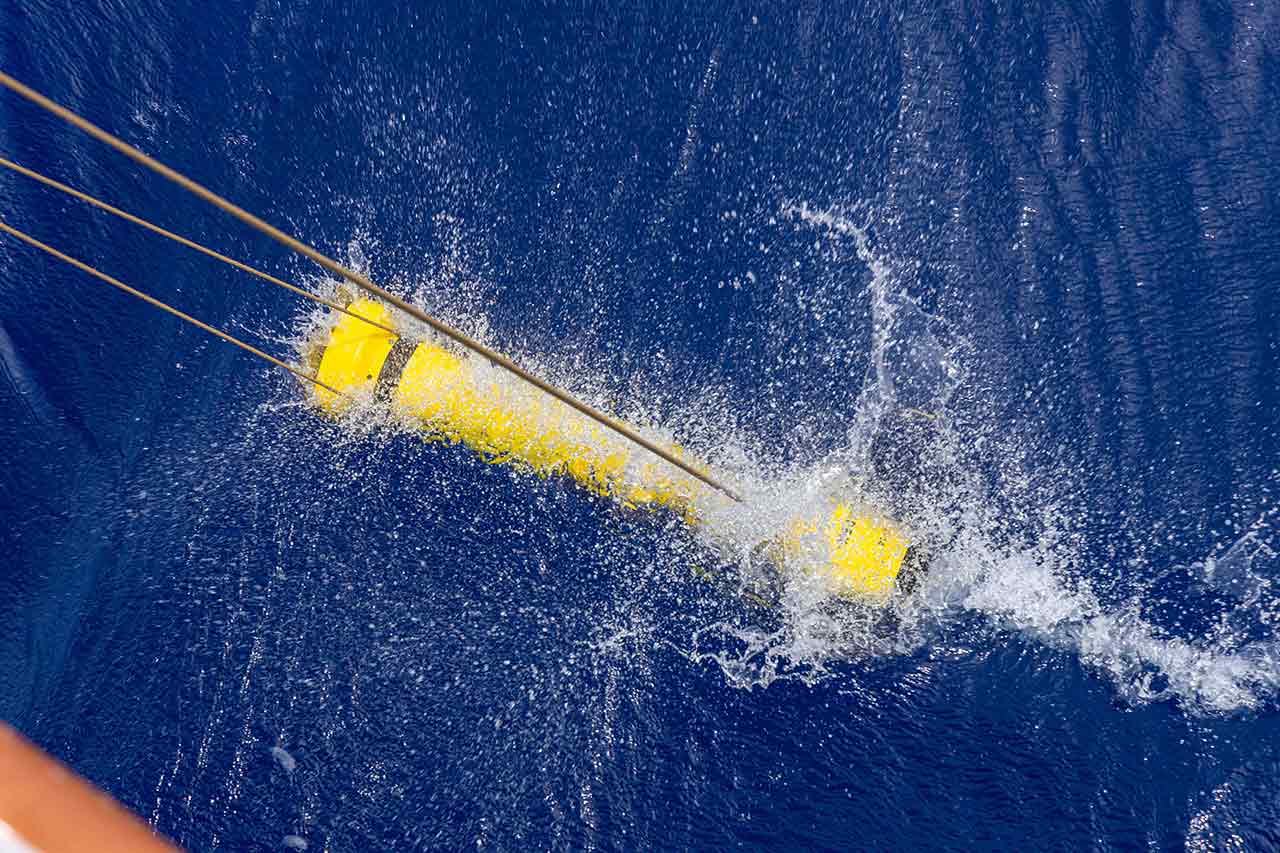
An Argo buoy is released into the sea. The buoy dives deep down measuring different parameters along the way, then resurfaces to transmit the collected data via satellite, repeating the cycle as long as the battery lasts. Photo: André Marton Pedersen
An Argo buoy is released into the sea. The buoy dives deep down measuring different parameters along the way, then resurfaces to transmit the collected data via satellite, repeating the cycle as long as the battery lasts. Photo: André Marton Pedersen

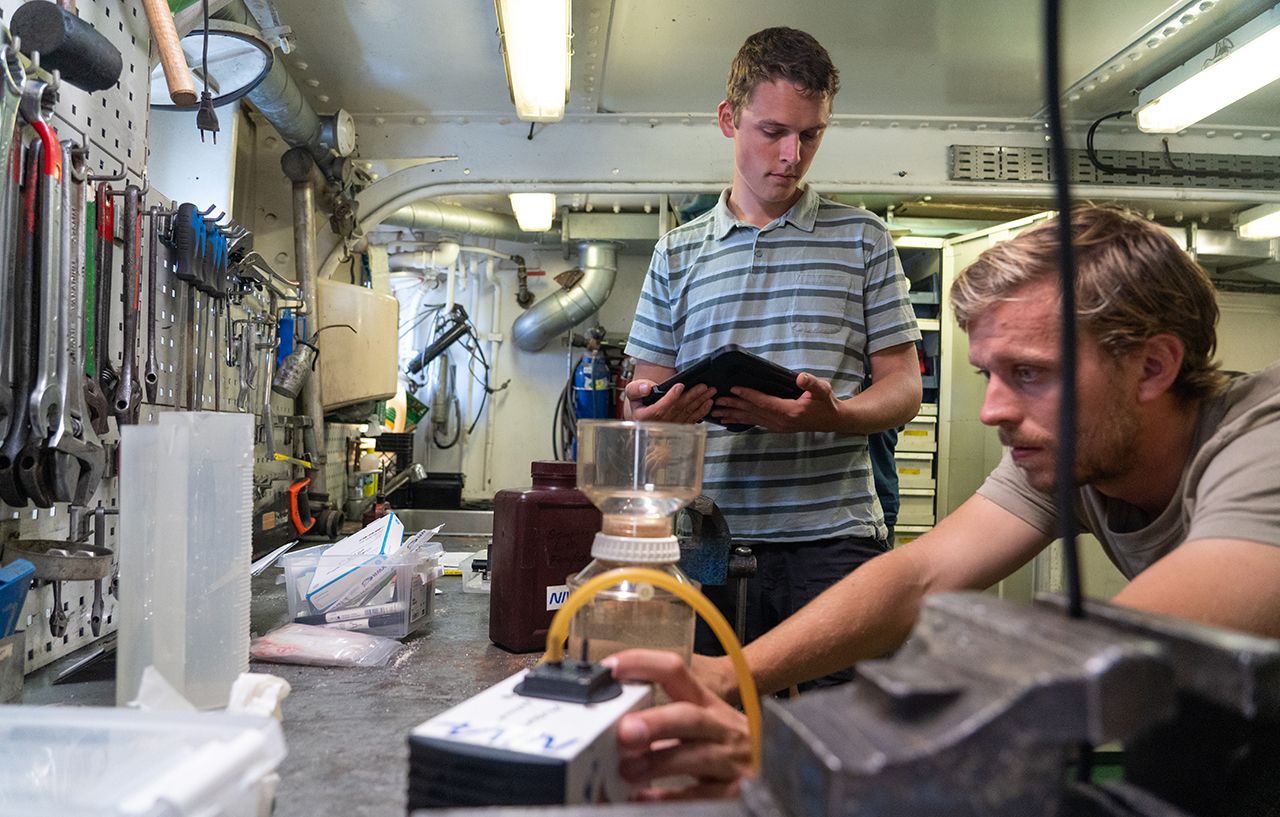
Erik Furevik and Erlend Mundal filtering in the lab. Photo: Ingrid Wollberg

Erik Furevik and Erlend Mundal filtering in the lab. Photo: Ingrid Wollberg

State-of-the-art

Statsraad Lehmkuhl was not built as a research vessel, but before departure it was equipped with state-of-the-art scientific instruments. The most important tools were sensors that collected data continuously throughout the voyage: an echosounder, a hydrophone, an autonomous pCO₂ instrument, and systems that sampled and analysed seawater taken in through an inlet in the hull - to measure environmental DNA and microplastics.

The scientific instruments

Increase knowledge

The goal of the data collection was to improve understanding of the state of the world’s oceans, with a particular focus on the distribution and diversity of organisms, environmental status, climate, and human pressures on marine ecosystems. Key questions included:

• How do biodiversity and indicators of human pressure vary across the world’s oceans?
• What is the distribution and vertical movement of mesopelagic sound-scattering layers globally?
• What characterizes the physical conditions and water masses encountered during the voyage, and can recurring phenomena such as internal waves and mesoscale eddies be detected?
• How much CO₂ does the ocean absorb from the atmosphere, how does this uptake vary in space and time, and how does it affect ocean acidification?
• How well do in situ observations correspond with satellite measurements of physical and chemical parameters?
• How well do observations, models, and satellite data align, and can these measurements be used to improve weather and ocean forecasting?

In June 2022, halfway into the first One Ocean Expedition, scientists meet in Rosendal in the Hardangerfjord, Norway, to review the data collected by Statsraad Lehnkuhl so far. Photo: Ronald Toppe

Publications

Analysing the large volumes of data has taken time, but the list of scientific articles and master’s theses is now extensive. Below are references to articles and Master thesis, published as of January 2026.

Is your publication missing from the list? Please inform us by email at science@ship.lehmkuhl.no.

Altiparmaki, O., Breivik, Ø., Aouf, L., Bohlinger, P., Johannessen, J.A., Collard, F., Donlon, C., Hope, G., Visser, P.N.A.M., Naeije, M., 2024. Influence of Ocean Currents on Wave Modeling and Satellite Observations: Insights From the One Ocean Expedition. Journal of Geophysical Research: Oceans 129, e2024JC021581. doi.org/10.1029/2024JC021581


Hasselberg, A.E., Frøyland, L., Kögel, T., Markhus, M.W., Plata, J., van der Meeren, T., Sørhus, E., Sanden, M., Lunestad, B.T., Hannisdal, R., Olsen, E., 2024. Maximizing the potential of sustainable aquatic food systems for global food security: key opportunities and challenges. Front. Ocean Sustain. 2. doi.org/10.3389/focsu.2024.1504689


Benetti, M., Sveinbjörnsdóttir, A.E., Ólafsdóttir, R., Leng, M.J., Arrowsmith, C., Debondt, K., Fripiat, F., Aloisi, G., 2017. Inter-comparison of salt effect correction for δ18O and δ2H measurements in seawater by CRDS and IRMS using the gas-H2O equilibration method. Marine Chemistry 194, 114–123. doi.org/10.1016/j.marchem.2017.05.010


Hegrestad, M., 2023. Microplastic in subsurface water in the South Pacific Ocean (Master thesis). The University of Bergen.


Huse, G., Batten, S., Schmidt, J., Isensee, K., Bahri, T., Skern-Mauritzen, M., Chiba, S., Haugan, P., 2025. Making ocean climate effects studies matter to society. ICES Journal of Marine Science 82, fsae200. doi.org/10.1093/icesjms/fsae200


Huse, G., Baussant, T., Becker, M., Biuw, M., Bødtker, G., Cook, J., Gomiero, A., Grøsvik, B.E., Handegard, N.O., Hestnes, A.J., Hole, L.R., Husson, B., Jaccard, P.F., Johannessen, J.A., Krolicka, A., Lien, V.S., Lindemann, C., Olsen, A., Renner, A., Lid, S.R., Steen-Larsen, H.C., Strand, E., Westgaard, J.-I., Pedersen, G., 2023. The One Ocean Expedition: Science and Sailing for the Ocean We Want. The One Ocean Expedition: Science and Sailing for the Ocean We Want.


Knoblauch, F.M., 2022. Measurement of Wave Properties with a Custom Built Sensor System as Part of the One Ocean Expedition (2021-2023): Technical Aspects and Post Processing of Field Data (Master thesis).


Lee, M.-C., Lin, J.-C., 2023. RoLA: A Real-Time Online Lightweight Anomaly Detection System for Multivariate Time Series. doi.org/10.48550/arXiv.2305.16509


Lund, M.N., 2022. Features impacting the mesopelagic layer in the ocean: a machine learning-based approach (Master thesis). The University of Bergen.
Moerman, B., Breivik, Ø., Hole, L.R., Hope, G., Johannesen, J.A., Rabault, J., 2024. An Analysis on Openmetbuoy-V2021 Drifter In-Situ Data Andlagrangian Trajectory Simulations in the Agulhas Current System. doi.org/10.2139/ssrn.5037638


Nakanowatari, T., Nakamura, T., Mitsudera, H., Nishioka, J., Nishikawa, H., Kuroda, H., Uchimoto, K., 2025. Decadal-scale reduction in net primary production in the western subarctic North Pacific: impact of lateral transport of dissolved iron from the Sea of Okhotsk. Environ. Res. Lett. 20, 054027. doi.org/10.1088/1748-9326/adc614


Ølberg, J.T., 2023. Wave Measurements Using Ship Mounted Sensors as part of the One Ocean Expedition (Master thesis). The University of Bergen.


Ølberg, J.T., Bohlinger, P., Breivik, Ø., Christensen, K.H., Furevik, B.R., Hole, L.R., Hope, G., Jensen, A., Knoblauch, F., Nguyen, N.-T., Rabault, J., 2024. Wave measurements using open source ship mounted ultrasonic altimeter and motion correction system during the one ocean circumnavigation. Ocean Engineering 292, 116586. doi.org/10.1016/j.oceaneng.2023.116586


Pykälä, T.-M., 2023. More-than-human agency on the Pacific Ocean (Master thesis). UiT The Arctic University of Norway.

More on ocean research during the 2020-23 One Ocean Expedition

See all articles